Lauren Bacall was tough, funny and sexy; Catherine Deneuve was meek, passive and expressionless. Germaine Greer laments the decline from feisty broad to simpering Barbie
Germaine Greer, Guardian, 30 Dec 2006
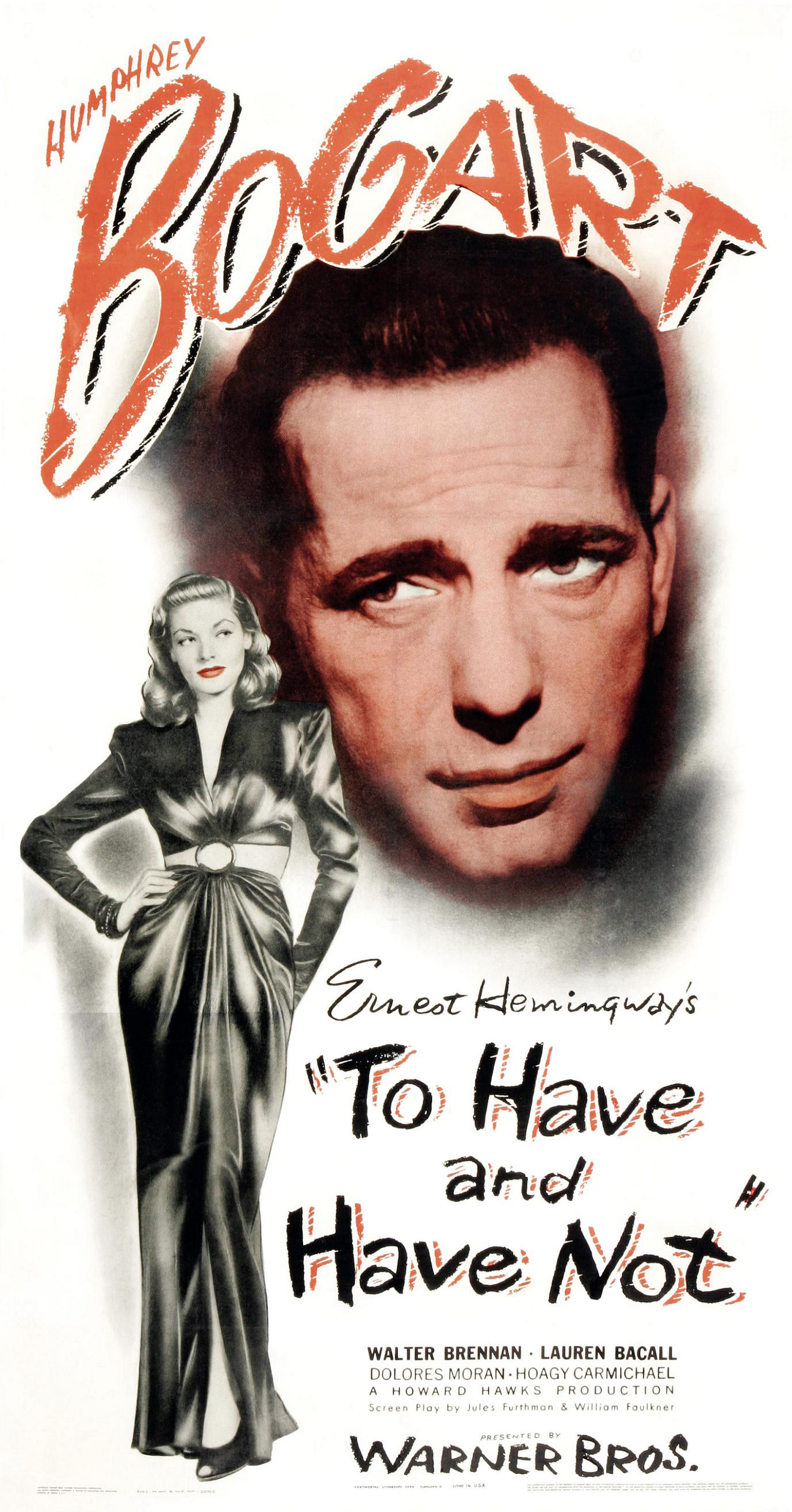
The movie phenomenon known as Lauren Bacall took time to put together. The woman who began life as Betty Joan Perske studied dancing for 13 years, then acting, and became a stage actress and model called Betty Bacall. Her picture on the cover of Harper's Bazaar caught the eye of the wife of movie producer Howard Hawks, who cast her in To Have and Have Not (1944) and created the movie star Lauren Bacall. She was not a regular beauty; her face was too broad, her mouth too wide, her eyes too far apart, and her ears too big. She was also neither blonde nor dark, but sallow and mousy.
Catherine Deneuve is the opposite. Everything about her is perfect: eyes beautifully set in perfect oval face, mouth neat, skin transparently fair, a body that could serve as the template for the first blow-up doll. Only her name and her hair colour were fake. She was born Catherine Dorléac, daughter of stage and screen actor Maurice Dorléac and his actress wife, whose maiden name she eventually took. Deneuve got her first screen role when she was only 13, and she has been in movies non-stop for 50 years. She never thought of doing anything else, and at 63 she still doesn't. She says she never works more than half of any year, but what she does with the other half is unknown.
 Bacall was 19 when she played her first scene opposite Humphrey Bogart; within a few weeks she was in his bed and his marriage to Mayo Methot was over. Already she was doing stuff that would reverberate through the decades. You can still see her as Slim Browning standing in the doorway, saying: "You know you don't have to act with me, Steve. You don't have to say anything, and you don't have to do anything. Not a thing. Oh, maybe just whistle. You know how to whistle, don't you Steve? You just put your lips together and ... blow."
Slim Browning - hotel thief, real name Marie - has won her new name from Harry Morgan (Bogart) because, when faced with extreme danger, she lost no smidgen of her cool. The name she was given was that of Hawks's second wife, the person who identified her as a Hawksian woman in the first place. Slim's coolness and courage also give her the right to initiate a sexual encounter, and to challenge her male partner, who has to challenge her right back. Their mutual wariness and occasional gruffness with each other builds the sexual tension between them to the point that when they finally get it on, we all feel like cheering.
Try as I might, I can't remember anything said by any character that Deneuve ever played, but the difference is as much one of era as of talent or personality. When Bacall came into the limelight the war was still on, and women were still self-sufficient, bouncing around in short skirts and chunky heels, talking loud and drawing a crowd. Before the Hays Code sanitised the movies in 1934, a series of remarkable actresses, including Bebe Daniels, Ruby Keeler, Ginger Rogers, Norma Shearer and Jean Harlow, had created female characters who managed to be tough, funny and sexy all at once.
In a way, I can see how Ruby Keeler would ber included in this group. She usually played the sassy virgin to counter-balance the more "experienced" dames embodied by Ginger Rogers or Joan Blondell. I love Ruby Keeler's films. I love Ruby Keeler as a movie star. But a remarkable actress she wasn't.
The type of spunky working girl was established by ex-chorus-girl Joan Crawford in the 1930s - most unforgettably as Flämmchen in Grand Hotel, which won best picture at the 1932 Academy Awards. Crawford was soon joined by Rosalind Russell, who was in her element playing feisty women such as the divorced reporter who ends up working for her ex-husband in His Girl Friday (1940), also directed by Hawks.
Hawks directed another unforgettably stylish, wisecracking, sexually aggressive female in Bringing up Baby (1938), namely Katharine Hepburn. In Only Angels Have Wings, made by Hawks the next year, Jean Arthur's character tells her male counterpart: "I'm hard to get, Geoff. All you have to do is ask me." These were women with their own agenda, who took risks knowingly, and took the consequences.
It was 1944 when Bacall joined the select group of Hawksian women. By the time Hawks had finished directing her in The Big Sleep two years later, time was running out for women who could give as good as they got. With all his clout in Hollywood, Hawks couldn't keep them alive. The war was over and women were back in the bedroom and the kitchen, working on the baby boom. Hawks's next starring ladies would be Marilyn Monroe (Gentlemen Prefer Blondes, 1953) and Joan Collins (Land of the Pharaohs, 1955) in the cinch-waisted, pointy-breasted, simpering 1950s.
By the time Bacall was teamed with Bogart again in 1948 in Key Largo, directed by John Huston [actually, they made Dark Passage for Delmer Daves one year earlier], hemlines had dropped and lipstick was pink, and nobody knew what to do with her. All she had to do in Key Largo was mime the family feeling and warm-hearted wifely innocence that went with high-heeled rope-soled espadrilles and a scraped-back hairstyle that showed her big ears. The thing Bacall always knew was how to pace a scene, how to time her lines, how to balance a word with a look. She didn't emote in any obvious way. It was all in the stillness, the upward glance, the few words. She had some successes in the 1950s, notably in Young Man with a Horn (1950), How to Marry a Millionaire (1953) and Designing Woman (1957), but they only went to prove that nobody was writing films for grown-up women. [I've always found Designing Woman to be an especially irritating film. I wouldn't have thought that the combined efforts of Bacall, Gregory Peck, Dolores Grey and Vincente Minnelli would result in anything this...shrill.]
Which is where Catherine Deneuve comes in. Her big breakthrough was Les Parapluies de Cherbourg (1964), a masterpiece of romantic French whimsy devised, written and directed by Jacques Demy, in which 20-year-old Deneuve played Geneviève, the 16-year-old daughter of the proprietress of a shop called Les Parapluies de Cherbourg. She and her mechanic boyfriend are in love and want to get married but he is called up for military service in Algeria. They go to bed together, he leaves, she bids him farewell at Cherbourg railway station - et voilà, she is pregnant. In fact, Deneuve had just given birth to her son by Roger Vadim when she started work on the movie.

Geneviève was a role for a French Olivia Newton John, and Deneuve was probably the nearest thing they had, but without a voice. What she did have was hair, as much hair comparative to the rest of her as any Barbie doll, and bleached beyond an inch of its life. The mass of hair did all the acting and most of the dancing for her. Under the hair was the perfect face, virtually expressionless, endlessly caressed by the camera. Though the plot requires Geneviève to jump the gun and have premarital sex with her boyfriend, Deneuve conveys not one scintilla of sexual desire. She might as well be going to the dentist as going to lose her virginity. Bacall could signify sexual interest with a glance; Deneuve cannot project it at all. This is not so much a matter of personality as of changed priorities.
Deneuve's film career began in 1963, when Roger Vadim cast her as Virtue in his film Le Vice et la Vertu. He had already moulded one young actress into the phenomenon called Brigitte Bardot, and it was only to be expected that he would create the Deneuve brand as well. Once he had identified Deneuve as Virtue, given her a baby and dumped her, she would continue in the same mould through film after film - meek, passive, expressionless. With a brow never furrowed and not a single laugh-line, she would take over from Bardot in 1985 as the face of Marianne, the symbol of the French republic, and her face would still be on the money 15 years later.
Deneuve's is what they call "time-less beauty"; she preserves it by keeping her revs very low. She comes to every role immaculately prepared, and she follows every directorial instruction to the letter. She begins by underplaying and allows the director, in her own phrase, to push her up, if he can be bothered. She has been described as "a receptacle for every conceivable imagination", and this is her strength in cinematic terms. Her cinematic presence is like the dress "the colour of time" that she wore in another of Jacques Demy's fantasies, Peau d'Âne, on which different images and colours were projected. Her effortless blankness allows her to take the imprint of her viewers' fantasies, and so she has achieved a reputation as one of the sexiest film actresses ever to grace the screen.
Belle de Jour (1967) has a reputation for being one of the sexiest films ever made, simply because Deneuve behaves throughout like a pre-adolescent girl. Through the prism of the 21st century, the film seems oddly contrived; what is now a cliche - the child who, subjected to the sexual advances of an adult, then becomes a frigid woman who is only turned on by squalor - is coyly exploited as a series of fetishistic images that juxtapose her fantasy life with her actual life. As Séverine Serizy, Deneuve moves through the imagery of what are meant to be her own fantasies like a sleepwalker. By her own account, director Lous Buñuel could not relate to her at all and never told her what he wanted. Unconsciously, she gave him what he wanted, which was as little as possible. The fantasies were his, after all.
The decision to have her dressed by Yves Saint-Laurent adds a bizarre dimension to the nonexistent plot; we seem to be living within the pages of a glossy magazine, with product placement everywhere. Everywhere Séverine goes, she is conspicuous by her catwalk presence, from her shiny patent leather pumps to the helmet that holds in her mane of Barbie-doll hair. The sex scenes in the brothel consist of her stripping to the full armour of suspender-belt, knickers, stockings and padded brassiere, and allowing ugly men to kiss her. In one extraordinarily unsexy sequence, she is required to process through the rooms of a ducal chateau dressed in nothing but a cloak of black georgette and a crown of white roses. She trots ahead of the camera like a lamb to the slaughter. She should have used a body double; it is typical of her passive obedience that she didn't. Lauren Bacall would never have done that for anyone, would never have stripped and had them shoot her bare arse from the back as she trotted through take after take. The Hawksian woman would have decked any man who asked her.
Buñuel used Deneuve again in Tristana (1970), a far better film than Belle de Jour but much less successful. Again, his real subject was not Tristana but himself. What activates the film is Buñuel's deep hostility to the hypocrisy of Spanish provincial society. Deneuve acts as the surrogate for his child self, the innocent orphan who is seduced by her guardian, who tries to express her own sexuality with a younger man who uses her; mutilated and helpless, she is forced to regularise a union with the man who took her virginity. What remains in the memory is not the shocking last scene or Deneuve's performance, but Buñuel's evocation of 1930s Toledo, seen as through the lens of childhood, wonderfully shot by José F Aguayo. Again, Deneuve's impassivity is exactly what Buñuel needs. It is the still point in his turning world.
Lauren Bacall's film career foundered in the 1950s, and never recovered. She has since played cameo parts and had considerable success on the stage [including Tony Awards for the musicals Applause and Woman of the Year]. Meanwhile, Catherine Deneuve has been, as well as the face of the republic, the face of Chanel No 5, and most recently the face of cosmetics companies MAC and L'Oréal.
The Hawksian woman was an idea that flourished at a time of crisis, in the depression and during the war, when the full energies of women were needed if they were to survive. After the war she was supplanted by the female eunuch, weighed down with huge hair and false eyelashes, unequal to any challenge - all things to all men and nothing to herself.
For further reading...
Lauren Bacall has written two memoirs: By Myself was first published in 1978 and an updated edition was released in 2005, under the title By Myself...and Then Some. By Myself is an exemplar of the memoir genre. Bacall is candid and honest - sometimes brutally - about her life, her marriage to Bogart in 1945 until his death from cancer in 1957; her later marriage to and divorce from Jason Robards; her experience as a Jewish model in the garment district in the early 1940s; the sudden rise and slow ebb of her film career; and her very unexpected success in two Broadway musicals.
Bacall's second book, Now, was published in 1994 and in its introduction, she is quick to point out that it is not a sequel to By Myself. Rather, Now is Bacall looking at her life as it was in 1994, rather than a review of everything that had happened since 1978. Each book is a delightful read; Bacall is one of the few memoirists who doesn't use a ghost writer and doesn't need one. She simply tells her (remarkable) story.
Maria DiBattista writes about many Hawksian women in Fast Talking Dames (2001), a look at women's roles in films of the 1930s. Chronologically, she doesn't get to Bacall's 1944 debut, but many Hawks-directed performances are examined, including Jean Arthur in Only Angels Have Wings, Katharine Hepburn in Bringing Up Baby and Rosalind Russell in His Girl Friday.
Howard Hawks's second wife, Nancy - aka Slim - the one who discovered Lauren Bacall on the cover of Harper's Bazaar, and on whom Bacall's character in To Have and Have Not was based, penned a memoir, Slim: Memories of a Rich and Imperfect Life, as Slim Keith. I haven't read it yet - though I did pick up a copy last weekend - but, according to Ms. Bacall, "This is the story of an American original - a woman of rare wit, intelligence, and beauty. Some of the most important men of our time were drawn to Slim Keith; to know why, one need only read this thoroughly entertaining book." And why would Lauren Bacall lie to me on a dust jacket?